By Laura Lewis, Certified Playground Safety Inspector
While contemplating the topic of my very first blog post, I encountered what I thought was an unusual issue three times in one month, so my blog topic was pretty much chosen for me. The problem? Residential-grade playground equipment meant for the backyard of a single family home, being installed in public use settings, such as at an HOA community park space.
For over six years now, I’ve been regularly conducting third-party safety inspections on public playgrounds in Central Florida, including many for HOA’s, and up until recently I had never personally ran into a residential-grade (aka “backyard” or “home”) playground in an HOA community park space. Then, in a matter of weeks, I heard from two different Community Association Managers in this situation, and also randomly noticed a residential-grade playground at an HOA clubhouse while dropping my son off at a friend’s house. As a playground safety inspector and as a parent, this was concerning, so I thought my first blog post was a great way to spread a little knowledge on the subject.
Home vs. Public Use Playgrounds
There are two distinct categories when it comes to playgrounds, “Home” and “Public Use”. Each have their own separate set of US Consumer Product Safety Commission (CPSC) safety guidelines and ASTM performance standards, all with the purpose of reducing life-threatening and debilitating injuries. These federal guidelines and performance standards differ greatly between “Home” and “Public Use” playgrounds. The applicable category is completely based on the location and use of the playground.
“Home” playgrounds are clearly defined as a playground located at a single family home or residential/home childcare facility. Where it gets confusing is that playgrounds located most everywhere else, with very few exceptions, are considered “Public Use” playgrounds, even if they are located on private property or charge a fee to be there. This would include public and private schools, city/state and community parks, non-residential childcare facilities, apartments, condominiums, hotels, resorts, restaurants and any other areas where children are invited to come play. Playgrounds at HOA communities are considered “Public Use” playgrounds, because multiple homeowners and their guests are allowed to use them.
Some Major Differences
Manufacturers design and produce playgrounds that align to either the “Home Playground” or the “Public Playground” set of safety guidelines and performance standards. There are a lot of differences between the two categories. Playgrounds manufactured for a single family home are typically residential-grade, while playgrounds manufactured for public use settings are always commercial-grade. Probably the most important difference is that public use equipment has strict structural loading requirements to accommodate many users, which is not the case for home playground equipment. This creates a major safety concern when multiple children in the community are playing at the same time on a set designed for one family in their backyard.
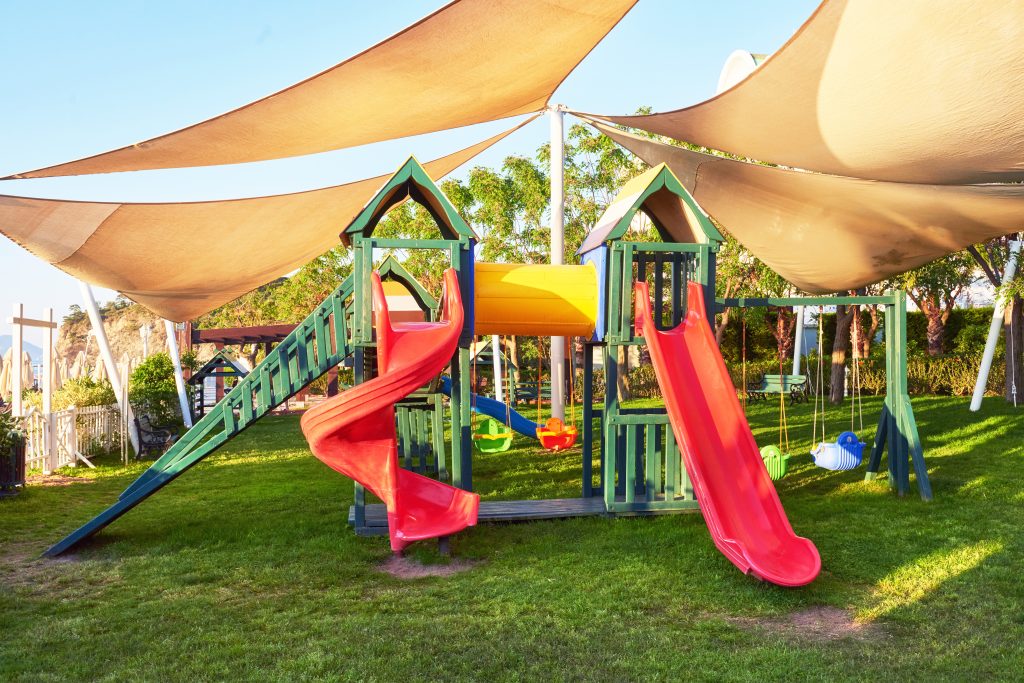
There are also several defined safety hazards and situations which are not allowed on public playgrounds due to historic injury data, but you may very likely find them on residential play sets because the guidelines for home playgrounds are less stringent. One of the most obvious differences is that swings on home playgrounds are allowed to be attached to the same support structure as other play activities, like climbers, platforms and slides. In contrast, with public use/commercial-grade equipment you will always see swings on their own separate support structure, with no other type of equipment located within the swing’s large use zone. This is due to the high probability of an impact injury when children are playing near moving swings. In case you missed it just now, if there are swings attached to the same support structure as other play activities (platforms, climbers, slides, etc.) on your community playground, this is a sure sign that you have a residential-grade playground intended for one family’s backyard. You will want to let your HOA leadership know right away so that they can do their research and understand the risks.
Other components which are allowed on home playground equipment but not on public use playgrounds, include trapeze bars and certain types of heavy, multi-user swinging elements (also impact hazards), as well as long ropes or chains that are not secured at both ends (strangulation hazards). These are just a couple of examples of the many differences between the home and public use playground standards, which become dangerous problems when a home playground is installed in a public use setting.
Not Worth the Short-Term Savings
Yes, residential-grade playground equipment is cheaper to purchase than commercial-grade, but a community may end up paying more in the long run for various reasons. Home playground equipment has a much shorter life span and is not designed to withstand the constant wear and tear of so many children like commercial-grade equipment. In addition, if an HOA decides to install a residential playground in a public use setting, the playground now needs to meet the guidelines for a public use playground, which may not be possible even with modifications, given all of the differences between the two categories.
One of the HOA clients I mentioned earlier had previously purchased and installed a residential playset from Amazon due to a very tight budget, but once they switched insurance companies to one that understood the risk, they had to remove the entire play set and start over, which was unfortunate.
The “Standard of Care” for Public Playgrounds
While there is not a governing body in Florida issuing citations for non-compliant public playgrounds, the risk is high when an organization doesn’t comply with the applicable guidelines and standards. Besides the safety concerns for the innocent children playing there, the organization will also have to deal with the legal consequences if an accident were to happen.
The CPSC Public Playground Safety Handbook is considered a federal guideline and the ASTM standards related to public playgrounds are consumer safety performance specifications which establish nationally recognized safety standards to address injuries identified by the CPSC. In all states, including those without state playground safety legislation, these resources have become the “Standard of Care” in court proceedings involving public playground injuries. Don’t let your HOA community expose themselves to this level of risk with a residential, backyard playground in their public use space.
Final Thoughts
Purchasing a new playground is an exciting time, but make sure to do your research to ensure your investment is wisely spent. If you are shopping for a public use space, always make sure you are looking for commercial-grade equipment. Sometimes advertisements for home/backyard playgrounds say the equipment “complies with CPSC/ASTM”, but it may actually mean it complies with the Home Playground standards and guidelines, not the Public Use Playground standards and guidelines, so be careful and ask questions.
Look for commercial manufacturers with a good reputation, whose sales reps take the time to educate you during the purchasing process….there is a lot to think about and they can be an invaluable resource. Purchasing from a reputable manufacturer can make a world of a difference in your experience, both before and after purchase. Choose wisely and don’t forget to have fun with it!
Laura Lewis is an active Certified Playground Safety Inspector through the National Recreation and Parks Association . In 2017, she created her Orlando-based business, Playground Safety Partners, which provides third-party playground safety inspections and consulting services to Central Florida schools, childcare facilities, government park agencies, HOA communities, Developers and Property Managers.
Backyard playground image by standret on Freepik